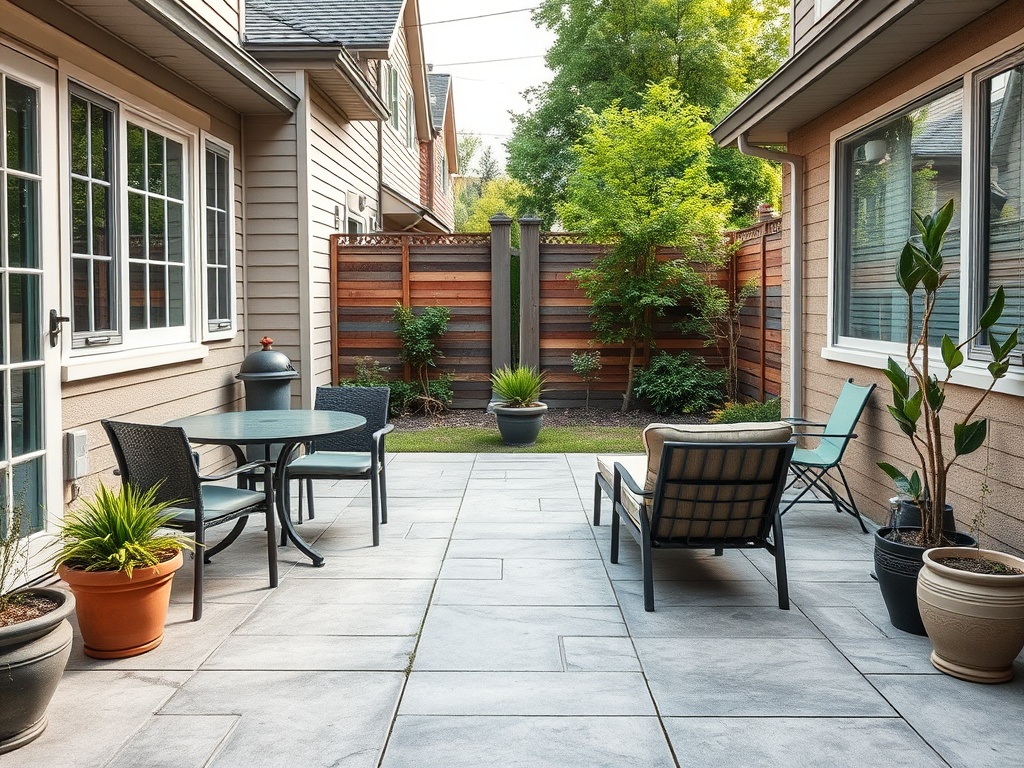
The best small-backyard patio layouts assign one primary purpose to the space, protect comfortable walking paths, and use furniture scale rather than furniture quantity to create function. A compact patio feels larger when dining, lounging, circulation, planting, and storage have clear places instead of competing for the same few feet.
Small-Patio Rule of Thumb: Decide what the patio must do most often, place the largest essential furniture first, preserve an unobstructed route from the house to the yard, then use corners and vertical surfaces for planting or storage.
Measure Before You Shop
A small patio is unforgiving of guesswork. Measure the available surface, every door swing, steps, gates, grill clearances, window wells, utilities, and the routes people use to reach the lawn or garden. Sketch the area to scale on graph paper or in a simple design app.
University of Georgia Extension’s base-map guidance recommends recording fixed structures and features before landscape design begins. The same practice is useful on a patio because an air-conditioning unit, hose bib, downspout, or door can eliminate a layout that looked perfect in a store display.
Layout 1: The Two-Chair Conversation Patio
This is the simplest layout for a very small backyard or townhouse courtyard. Place two appropriately scaled chairs at an angle with a compact side table between them. Use a wall, fence, hedge, or planting bed to create a sense of enclosure, but keep the seating far enough from the boundary for comfortable use and maintenance.
Layout 2: A Compact Dining Zone
For households that eat outdoors, make the table the anchor. A round or small square table can reduce sharp circulation corners, while a narrow rectangular table can fit along a wall. Folding or stackable chairs provide flexibility when the patio also serves as a route to the yard.
Place the table where chairs can be pulled out without blocking a door or step. If the patio is directly outside the kitchen, keep the most direct serving route open instead of centering the table purely for symmetry.
Do not place grills or open-flame cooking equipment based only on convenience. Follow the equipment manufacturer’s clearance instructions and local fire rules, especially near siding, fences, overhangs, and combustible furniture.
Layout 3: Bench Seating Along One Edge
A built-in or freestanding bench can concentrate seating along the perimeter and leave the center open. This works particularly well against a masonry wall, sturdy fence line, or raised planter where the bench does not interfere with access.
A bench also creates a natural transition to planting. Keep thorny, brittle, or bee-attracting plants away from the immediate sitting zone if occupants are likely to brush against them frequently.
Layout 4: Split Dining and Lounge Zones
A slightly larger small patio can support two uses if each zone is modest. Put dining nearest the kitchen or main door and a pair of lounge chairs toward the garden edge. Use an outdoor rug, change in paver direction, or planter grouping to distinguish the zones without building a physical divider.
Penn State Extension’s guidance on creating outdoor rooms describes how ground-plane changes and vertical elements can define different outdoor functions. In a small yard, implied separation is usually more space-efficient than solid walls.
Layout 5: The Corner L
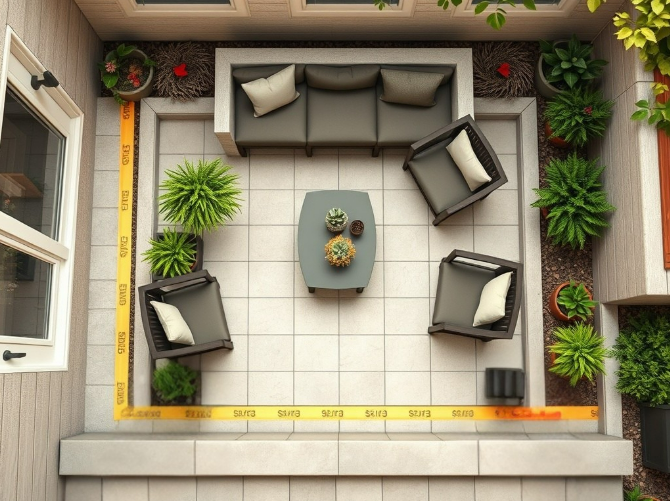
An L-shaped bench or compact sectional can make use of a dead corner and provide more seats than scattered chairs. The risk is scale. A deep sectional designed for a large deck can consume the entire patio, leaving no comfortable route through the space.
Measure both the furniture footprint and the space people need to sit down and stand up. If the corner layout blocks a view from inside the house or creates a narrow pinch point, two separate chairs may work better.
Layout 6: A Flexible Open-Center Patio
For a multipurpose yard, keep the center mostly open and use lightweight furniture around the perimeter. A folding table can come out for meals, children’s activities, or projects and then be stored. This layout is useful when the patio is also a path to a garden shed, lawn, or side gate.
Compare Layouts by the Way You Use the Yard
| Layout | Best for | Space efficiency | Main trade-off |
|---|---|---|---|
| Two-chair conversation | Couples, reading, morning coffee | Excellent | Limited capacity |
| Compact dining | Outdoor meals | High | Chair movement needs clearance |
| Perimeter bench | Extra seating and open center | High | Less flexible once installed |
| Split zones | Dining plus lounging | Moderate | Requires disciplined furniture scale |
| Corner L | Social seating | High when correctly sized | Can feel bulky in narrow yards |
| Flexible open center | Multiuse households | Excellent | Requires storage and movable pieces |
Use Vertical Space for Greenery
When floor area is limited, vertical planting can add softness without consuming circulation space. Wall-mounted planters, trellises, tall narrow containers, or a vine support can work where the structure is suitable. Do not attach heavy planters to a fence or wall without confirming the structure can carry the load.
Privacy Should Not Turn Into Confinement
Small patios often need screening from neighboring windows or close property lines. Use partial rather than complete enclosure when possible: a trellis, tall container grouping, layered shrubs, or a short screen can interrupt the sightline while preserving light and airflow.
Before adding permanent privacy structures, check property lines, fence-height rules, homeowner-association requirements, and utility access. Leave enough room to maintain both the screen and the boundary behind it.
Lighting Should Clarify Edges and Steps
Low-level path or step lighting improves safe movement after dark. Accent lighting can then highlight a wall, tree, or planting. Keep fixtures shielded and modest so the small yard does not feel overlit.
Permanent electrical work must meet local code. Battery or solar lighting can be simpler, but brightness and runtime depend on product design and available sunlight. Treat lighting as a layered system rather than a collection of decorative fixtures.
Keep the Garden Tools Out of the Seating Zone
A compact patio can become a storage area quickly. Create a dedicated place for pruners, trowels, hose fittings, and cushions. If you already have rusty or dull garden tools, clean and store hand tools properly before designing storage around them.
The patio itself should remain easy to sweep and inspect. Keep mulch and soil from washing onto the surface, and correct drainage that leaves persistent puddles.
Let the Landscape Borrow Space Visually
A small patio can feel less confined when it opens toward an attractive planting bed, lawn, or focal tree. Instead of screening every boundary equally, preserve the best view and block only the least attractive one. Align a chair or bench with that view so the yard beyond feels like part of the room.
Turf can provide visual openness, but its suitability depends on climate and shade. If you are deciding what to plant around the patio, compare cool- and warm-season turf before assuming one grass type will perform everywhere.
Choose the Layout That Solves Your Most Frequent Need
For the smallest yards, two comfortable seats are better than six cramped ones. For frequent meals, a correctly sized table matters more than a decorative lounge chair. For families using the space for several activities, an open center and movable pieces may be the smartest investment.
Tape the furniture footprints onto the patio before buying anything. Walk the route from the door to the yard, pull imaginary chairs out, open the grill lid or storage bench, and carry a tray through the space. If the taped layout works in real movement, the finished patio is much more likely to feel comfortable.
This outdoor-living information is educational and general. Patio construction, structural attachments, electrical work, fire clearances, drainage, property lines, accessibility, and permit requirements vary by location and product; follow local codes and manufacturer instructions and use qualified professionals when appropriate.