Native plants are often the stronger choice when your goals include supporting local wildlife, reducing invasive-species risk, and creating a landscape tied to regional ecology. Non-native ornamentals can still be appropriate when they are noninvasive, well adapted to the site, and fill a legitimate design or functional role; the key is to judge individual plants rather than treating every non-native species as harmful.
Plant-Choice Perspective: Prioritize site fit and invasive status first. Then weigh wildlife value, water and maintenance needs, availability, appearance, and the role the plant must perform. “Native” is an ecological category, not a promise that every species will thrive in every yard.
Native and Non-Native Are Not the Same as Good and Bad
A native plant occurs naturally in a region and has ecological relationships that developed there over time. A non-native plant originates outside that region. An invasive plant is a non-native species that spreads in ways that cause or are likely to cause ecological, economic, or health harm. Those definitions should not be collapsed into one label.
The National Park Service’s discussion of non-native plants notes that many non-native species were introduced for ornamental or practical purposes and that only some become invasive. That distinction matters for home landscapes. A well-behaved non-native ornamental is not equivalent to an invasive plant escaping into natural areas.
At the same time, invasive potential is one of the first screening questions to ask before planting. Local invasive-plant lists are more useful than a generic national list because a species can behave differently across climates.
Native Plants Often Provide Stronger Wildlife Connections
Native insects, birds, and other wildlife frequently rely on plants that evolved in the same region. Penn State Extension’s native-plant guidance explains that native plants can provide food and habitat for native insects and wildlife, including the plant-eating insects that support larger food webs.
That is a major reason to include native trees, shrubs, grasses, and flowering perennials when biodiversity is a priority. Nectar is only one part of the relationship. Leaves, seeds, fruits, stems, bark, nesting structure, and host-plant relationships also matter.
Site Fit Still Comes Before the Label
A native plant can fail when it is placed in the wrong soil, light, moisture, or exposure. A species native to a wet woodland may perform poorly in a hot dry parking-strip bed even if both locations are within its broad geographic range.
Before buying, record sunlight, drainage, soil texture, mature-space limits, deer pressure, salt exposure, and irrigation access. Then select plants native to the relevant region that naturally tolerate those conditions. “Right plant, right place” remains the more useful horticultural rule.
Native vs Non-Native Ornamentals at a Glance
| Consideration | Native plants | Non-native ornamentals |
|---|---|---|
| Wildlife relationships | Often support more region-specific food and habitat connections | Value varies widely by species |
| Invasive risk | Native species are not classified as invasive in their native range, though some can spread aggressively | Must be screened for invasive behavior in the local region |
| Site adaptation | Can be well adapted when matched to the correct local habitat | Some are highly adaptable; others need extra inputs or protection |
| Aesthetic range | Broad, from naturalistic to formal depending on species and design | Extremely broad nursery selection and familiar ornamental traits |
| Maintenance | May be relatively low after establishment when site matched | Can be low or high depending on species and site |
| Availability | Improving but can vary by region and nursery | Often widely available in conventional retail channels |
Water Use Depends on the Plant and the Site
Native plants are frequently described as low-water choices. That can be true when a species is adapted to local rainfall and the specific planting site, but it should not be treated as a universal guarantee. A native wetland plant is not a drought plant simply because it is native.
New plantings also need establishment water. Even drought-adapted species can fail when transplanted into dry soil and neglected during root establishment. Once established, locally adapted natives may need less supplemental irrigation than poorly matched ornamentals, but exact needs vary.
If you are redesigning irrigation along with planting, compare drip and soaker options for shrubs, perennials, and garden beds rather than applying the same schedule to every plant.
Maintenance Claims Need Context
Some native landscapes require less mowing, fertilizer, pesticide use, and supplemental water than conventional high-input landscapes. That does not mean they require no work. Young native plantings need weed control, watering during establishment, editing, and sometimes seasonal cutting or pruning.
Likewise, some non-native ornamentals are exceptionally durable and low-maintenance in appropriate settings. The useful comparison is not native versus ornamental in the abstract. It is species A versus species B for a specific soil, light level, mature size, ecological goal, and maintenance budget.
Aesthetic Style Is a Design Choice
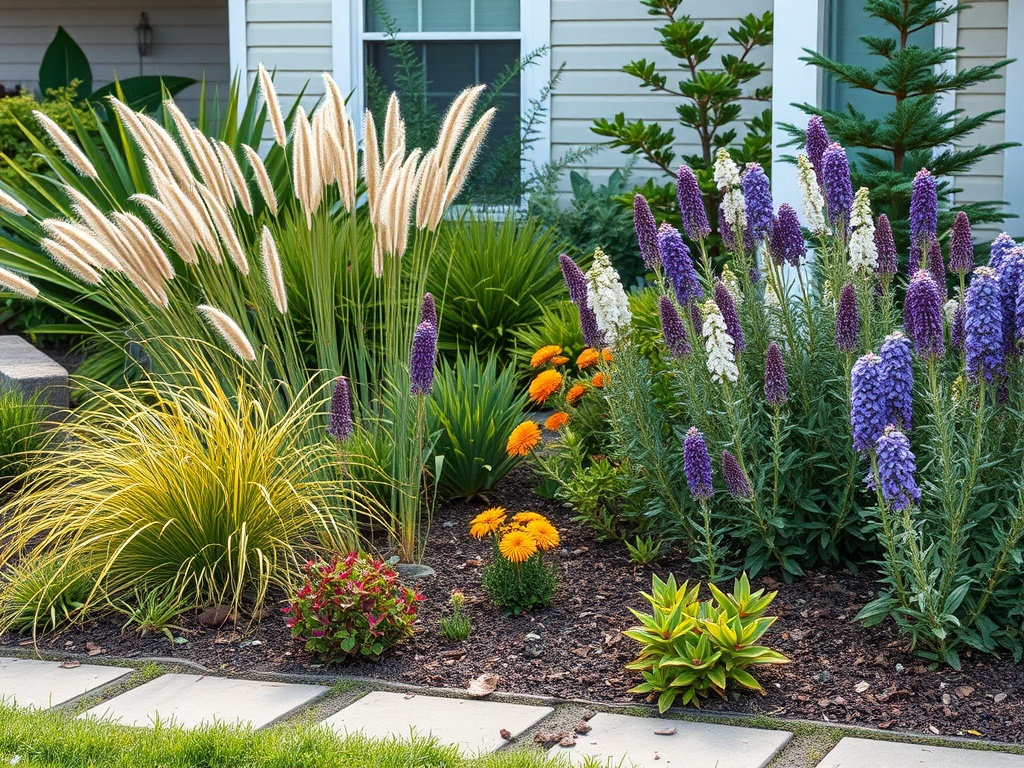
Native planting does not have to look wild. Repetition, defined edges, intentional spacing, layered heights, and a limited palette can make native plants work in formal or contemporary landscapes. Conversely, a non-native ornamental border can look informal and naturalistic.
Invasive Species Are the Red Line
Before purchasing a non-native ornamental, check state or regional invasive-species lists. Do not rely only on a nursery tag or national reputation. A plant that is restricted in one jurisdiction may still be sold in another, and regulations change.
Avoid plants known to escape cultivation in your region, especially near natural areas, waterways, or woodland edges. If you already have an invasive ornamental, follow local recommendations for removal. Some species resprout from roots or spread through seed, so cutting alone may not solve the problem.
The National Park Service describes how invasive non-natives can outcompete native species and disrupt ecological relationships. For a home garden, prevention is usually easier than controlling a plant after it has spread beyond the bed.
Build a Mixed Landscape Deliberately
A practical compromise for many homeowners is a native-forward landscape with carefully selected non-native accents. Use native trees and shrubs as the structural backbone, add native flowering plants and grasses for seasonal habitat, then include noninvasive ornamentals where they provide a specific color, form, evergreen screen, or cultural connection you value.
The proportions are a preference. If habitat is the dominant goal, increase native diversity and reduce ecologically low-value lawn or ornamental massing. If a formal aesthetic is the dominant goal, select natives that respond well to the intended shape and spacing rather than forcing prairie species into a tightly clipped scheme.
Soil Health Supports Either Planting Strategy
Plant origin cannot compensate for severely compacted, contaminated, or poorly drained soil. Improve the site appropriately before planting. Organic matter may help some soils, but amendment practices should be based on soil conditions and plant needs rather than a fixed recipe.
Finished compost can be useful in beds, and raised-bed soil principles offer a useful reminder: soil structure, drainage, and keeping foot traffic out of planting zones are as important as adding nutrients.
Choose Plants With a Three-Question Filter
First, is the plant invasive or restricted where you live? If yes, choose something else. Second, does the plant match the actual site conditions and mature-space limits? If no, choose something else. Third, does it advance your goal, whether that is habitat, shade, privacy, seasonal color, erosion control, or a specific design effect?
After those questions, native status becomes a powerful positive factor rather than a slogan. A well-chosen native plant can support regional ecology and fit the landscape beautifully. A well-chosen non-native can still have a place when it is noninvasive and appropriate. The strongest landscapes make those choices intentionally.
This landscaping information is educational and general. Native ranges, invasive-species regulations, drought response, plant availability, and maintenance needs vary by region and site; consult current state invasive-plant lists and local Extension or conservation resources before planting.