You can improve ball control without a full team or regulation court by training touch quality, body position, scanning habits, and pressure simulation in a small safe space. The goal is not flashy repetition; it is cleaner control when your attention is split.
TL;DR:
- Use short blocks: stationary control, movement control, change-of-direction, decision cues, then fatigue control.
- Measure progress with weaker-side reps, control errors, timed sequences, and how quickly you recover after a mistake.
- Keep the space safe, use sport-appropriate footwear, and avoid drills that encourage reckless speed in cramped areas.
Cluster: Skills, Training & Drills | Intent: Informational | Audience: Intermediate | Funnel: Top of Funnel
Why limited-space practice still transfers
Ball control is partly technical and partly perceptual. A player has to keep the ball within reach, adjust body shape, and make the next decision while moving. A full court helps, but it is not the only place where these habits are built. Small-space work can increase touches, expose weaker-side control, and make each movement more deliberate.
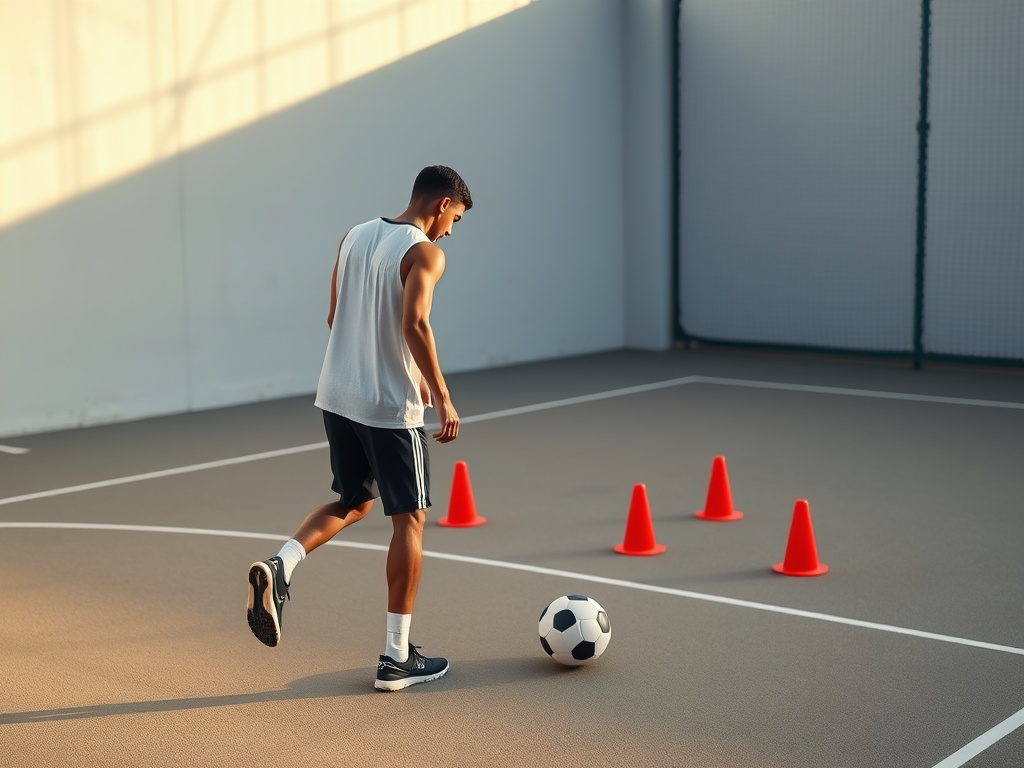
Set up a compact training area
Choose a flat surface with enough room to stop safely. Mark a narrow lane, a square, and two gates using cones, bottles, or safe household objects. If the ball is for basketball, use a surface where bouncing is allowed. If it is for soccer or futsal, use a ball that will not damage walls. USA Basketball’s youth guidance emphasizes development, enjoyment, and health, which is a useful reminder that solo work should support long-term improvement rather than punishment. Readers can connect this with How to Improve Aerobic Fitness Without Losing Power and Speed for a practical next step and review USA Basketball youth guidelines when they need an authoritative reference.
The five-part control sequence
Start with two minutes of stationary touches, focusing on posture and quiet hands or feet. Move to controlled walking pace. Add direction changes every three touches. Next, add a cue: look up, call a color, change hand, switch foot, or pass through a gate. Finish with a short fatigue block where the goal is accuracy, not speed. This sequence works because it moves from control to decision-making.
| Focus area | What it means | How to use it |
|---|---|---|
| Stationary control | Clean touch mechanics | 30 seconds each side |
| Moving control | Touch while changing pace | Four short lanes |
| Decision cue | Look up and react | Color or sound cue |
| Fatigue control | Maintain form tired | 20-second finisher |
Coaching cues that matter most
Keep your center of mass balanced. Let the ball stay close enough that you can protect it, but not so close that every touch becomes cramped. Use the weaker side early in the session before fatigue makes form sloppy. Look up between touches. If you cannot look up, slow the drill until the control becomes stable. For a related angle, see How to Reset After a Mistake During Competition, then compare the idea with FIBA official basketball rules where relevant.
Ways to create pressure without defenders
Use time limits, smaller gates, weak-side-only reps, a random audio cue, or a second task such as calling out numbers. Pressure should make the drill slightly harder, not chaotic. A drill that causes constant errors teaches frustration more than skill. If you need a sport-specific base, official basketball rules and USA Basketball development resources can help distinguish legal movement from bad habits.
Track improvement like a coach
Record three numbers: successful reps, errors under control, and recovery time after an error. Recovery matters because competition never gives perfect conditions. Link solo control work with mental routines from reset training and with conditioning that preserves power, rather than turning every skill session into exhausting cardio.
Applied checklist for practice ball control when you don’t have a full team or court
Before using the advice, define the exact situation. A fan, athlete, coach, parent, buyer, or player should know what decision is being made, what information is reliable, and what can be tested immediately. Write down the current goal in one sentence. Then choose the smallest action that would make the next practice, game, purchase, or viewing experience clearer. This keeps the article practical instead of turning it into background reading only.
Use a three-part checklist: context, action, and review. Context asks where the advice will be used and what limits exist. Action asks what the reader will do first. Review asks what evidence will show progress or a better decision. In sports and games, that evidence may be cleaner execution, safer behavior, lower cost, better understanding, more confident communication, or less emotional reaction under pressure.
Keep the checklist honest. Do not count a single good result as proof that the whole approach works, and do not treat one poor result as failure. Game environments vary. Courts, fields, opponents, teammates, devices, venues, rules, and personal stress can all change the outcome. The most useful habit is to compare similar situations over time and adjust one variable at a time.
Quality signals to watch in practice ball control when you don’t have a full team or court
The strongest signal is repeatability. A term is understood when the reader can recognize it during live play. A drill is working when control holds up under mild pressure. A buying decision is sound when the product or ticket fits the actual use case, not just the marketing claim. A mental routine is useful when it shows up after an error, not only during calm practice. A ranked routine is healthy when it supports learning without turning every session into a stress test.
The second signal is transfer. Advice should move from the page into a real setting. For athletes, that might mean using the cue during a scrimmage. For coaches, it might mean changing a constraint and observing a better decision. For parents, it might mean asking sharper questions before joining a program. For fans, it might mean watching a game with more confidence and fewer assumptions. Transfer is more valuable than memorization.
The final signal is sustainability. A plan that only works when the reader has unlimited time, money, energy, or perfect conditions is fragile. Good sports guidance respects recovery, safety, budget, access, and motivation. It also leaves room for uncertainty. When a claim involves current rules, ticket policies, eligibility, rankings, or official procedures, the reader should check the relevant authority before acting.
A useful final test is whether the reader can explain the idea to someone else in plain language. If the explanation becomes complicated, return to the simplest version: what is happening, why it matters, what action comes next, and what evidence would show improvement. That four-part pattern keeps the guidance practical for beginners while still giving intermediate readers enough structure to refine their choices. It also makes the article easier to revisit later, because the reader can scan the main cues and apply them again without starting from zero.
For readers building a broader foundation, Basketball Shoe Buying Guide: Cushioning, Grip, and Ankle Support adds another perspective without pulling this article away from its main topic.
Turn small spaces into useful repetitions
Use this article as a practical reference, then apply one small piece during the next practice, match, purchase decision, or viewing session. The best next step is not to memorize everything at once; it is to test one idea, observe the result, and build from there.