Drip irrigation gives you more control over where and how much water is delivered, while soaker hoses offer a simpler setup for straightforward beds and rows. Both can reduce foliage wetting and direct water near plant roots, but they differ in precision, cost, maintenance, layout flexibility, and how well they handle long or uneven runs.
Watering Choice in One Minute: Pick drip irrigation for permanent beds, mixed plantings, containers, or zones that need adjustable emitters. Pick a soaker hose for a simple bed where plants have similar water needs and you value quick installation over fine control.
What Both Systems Do Well
Drip lines and soaker hoses are low-volume watering methods that place water at or near the soil surface. That is fundamentally different from broadcasting water over a wide area with a conventional sprinkler. The EPA WaterSense microirrigation guidance explains that low-pressure systems deliver water slowly to the root zone and can reduce runoff and evaporation when they are designed and maintained correctly.
Both systems can be useful around vegetables, shrubs, and ornamental beds. They also keep pathways and much of the foliage drier than overhead watering. That can make the garden easier to work in and may reduce some moisture-related plant problems, although disease risk depends on the crop, weather, and pathogen.
Side-by-Side Comparison
| Feature | Drip irrigation | Soaker hose |
|---|---|---|
| Water delivery | Through individual emitters or dripline outlets | Seeps through a porous hose wall |
| Precision | High; emitters can be placed or selected by need | Moderate; water is distributed along the hose length |
| Best fit | Mixed beds, containers, permanent layouts, widely spaced plants | Simple rows, narrow beds, closely spaced plantings |
| Installation | More components and planning | Faster and simpler |
| Pressure management | Often needs regulator and filter | Usually benefits from low pressure and short sensible runs |
| Maintenance | Flush lines, clean filters, inspect emitters | Check for uneven seepage, kinks, mineral buildup, deterioration |
| Layout changes | Easy to reconfigure with fittings | Simple to move, but less precise around isolated plants |
| Cost profile | More upfront parts; scalable | Lower-complexity entry option |
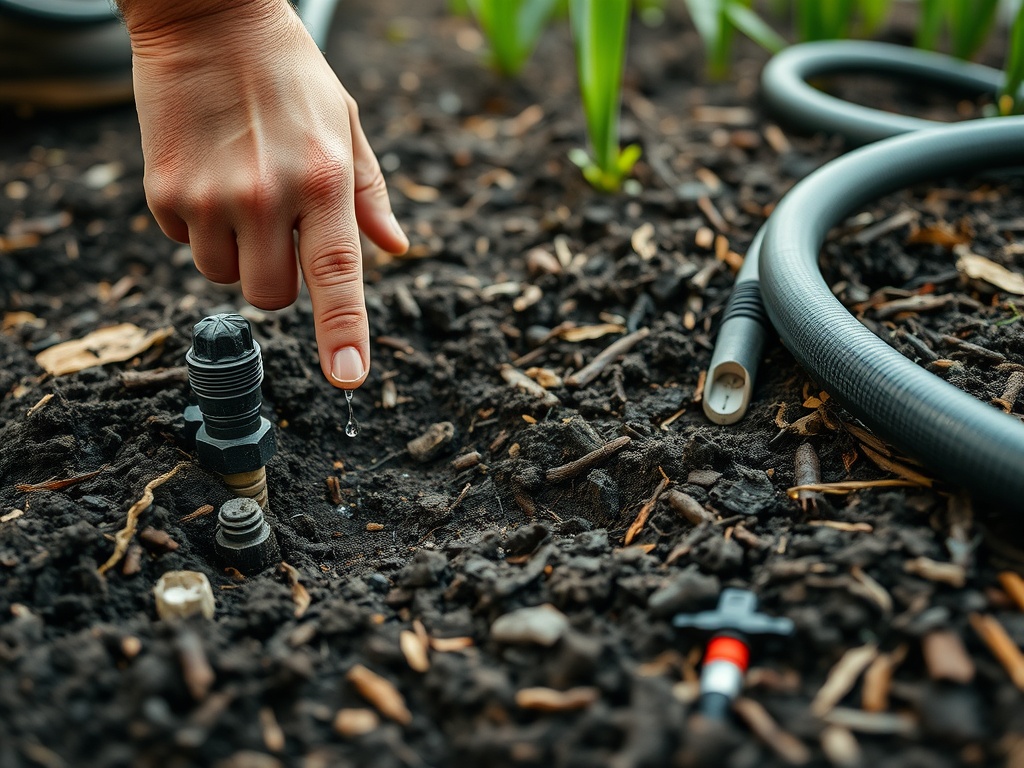
Drip Irrigation Gives You Zone-Level Control
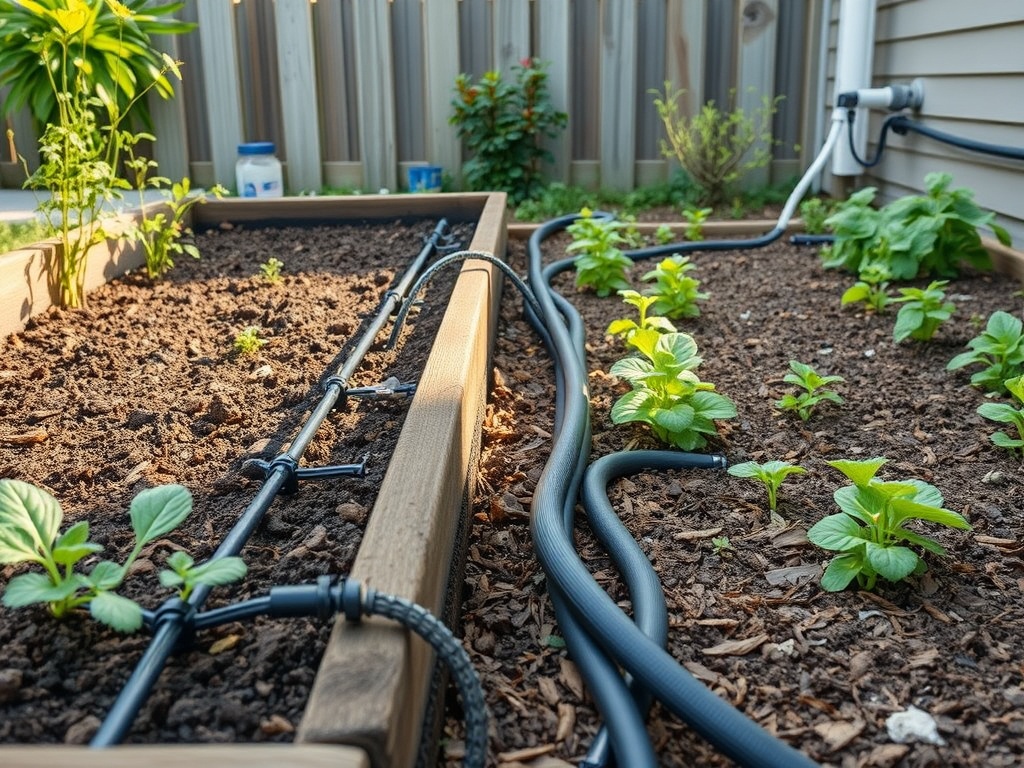
A basic drip system usually includes a water source connection, backflow protection where required, filter, pressure regulator, main tubing, and emitters or dripline. The exact components depend on the system and local plumbing rules. EPA WaterSense material emphasizes pressure regulation, filtration, and flushing because low-flow outlets are sensitive to debris and incorrect pressure.
The main advantage is control. One plant can receive water from a point-source emitter while a row of greens receives water from inline dripline. You can keep water off empty soil and adjust a zone as plant spacing changes.
That control is useful in a raised bed holding crops with different spacing. The article on raised-bed vegetable choices explains why compact greens, larger peppers, and trellised crops may share a bed but occupy water and space differently.
The disadvantage is complexity. Each fitting is another potential leak point, and a poorly filtered system can clog. Installation also takes more planning than laying down a hose.
Soaker Hoses Win on Simplicity
A soaker hose is porous along much of its length. Water seeps through the hose and wets the adjacent soil. For a straight vegetable row or a narrow flower bed, that can be enough. There are fewer small fittings and emitters to position, and the hose can be placed quickly under a light mulch layer where the manufacturer permits.
The trade-off is unevenness. Long runs, elevation changes, pressure variation, and aging hose material can cause one section to release more water than another. A gardener may assume the entire line is performing equally because the hose looks the same from end to end.
Use short, practical zones, check the soil at several points, and avoid judging performance only at the faucet end. The goal is uniform root-zone moisture, not a specific number of minutes on a timer.
Water Pressure and Filtration Matter More for Drip
Drip systems operate at relatively low pressure. A pressure regulator helps keep the system within the range expected by its components, while filtration reduces clogging. EPA WaterSense also recommends routine inspection and cleaning of microirrigation filters as needed.
If your water contains sediment or minerals, maintenance becomes more important. Flush lines according to the manufacturer’s instructions and inspect emitters for reduced flow. With a soaker hose, mineral deposits can also reduce seepage over time, but the remedy may be cleaning or replacing the hose rather than servicing individual outlets.
Which System Handles Raised Beds Better?
Both can work. Dripline is often better for a bed with predictable plant rows because you can run parallel lines and control spacing. Point-source drip is helpful for widely spaced tomatoes, peppers, or perennial herbs. A soaker hose is convenient for a bed filled with greens or other closely spaced crops where broad, even wetting along a line is acceptable.
Do not place a single hose down the center of a wide bed and assume water will move evenly to both edges. Soil texture changes lateral water movement. Sandy soil tends to let water move downward quickly, while finer-textured soil may spread moisture differently. Test the actual wetting pattern before finalizing the layout.
Which Is Better for Water Conservation?
A well-designed microirrigation system can be very efficient, but equipment alone does not guarantee savings. Runtime still matters. An emitter system that runs too long can overwater just as surely as a sprinkler. EPA’s WaterSense watering tips recommend adjusting irrigation for seasonal conditions and inspecting systems for leaks, clogs, and other problems.
Soaker hoses can also be efficient when they are used at low pressure and placed where plants need water. Their limitation is that you have less control over individual output points.
Mulch Helps Both Systems Work Better
A light organic mulch can reduce evaporation from the soil surface and moderate temperature. Place irrigation under the mulch where appropriate so water enters the soil instead of wetting the mulch first. Keep mulch away from plant crowns and woody stems when constant moisture would create problems.
Compost and mulch play different roles. If you are improving bed soil, review the compost basics before adding large quantities of organic material. Finished compost is a soil amendment; mulch is primarily a surface layer.
Maintenance Problems to Watch
For drip irrigation, common issues include clogged emitters, disconnected fittings, cracked tubing, missing end caps, and pressure that is too high or too low. For soaker hoses, watch for kinks, split sections, inconsistent seepage, and deterioration from sunlight or storage.
At the start of the season, run the system while you can see it. Look for leaks and blocked outlets before burying lines under mulch. During hot weather, check actual soil moisture near roots rather than increasing runtime automatically.
If plant damage is being mistaken for a water problem, identify insects or disease before changing irrigation dramatically. Organic pest-management guidance can help separate pest symptoms from general plant stress.
Choose by Garden Complexity
Choose drip irrigation when you want a permanent, adjustable system that can serve mixed plant sizes, containers, or multiple zones. Choose a soaker hose when the bed is simple, the run is modest, the plants have similar needs, and you want a low-complexity installation.
For a small garden, either system can work well if you observe it. Lay out the line, run it briefly, dig a few small test holes after watering, and see how far moisture moved. Adjust spacing and runtime based on the soil you actually have rather than an online schedule written for someone else’s climate.
This irrigation information is for general educational use. Watering needs, plumbing/backflow rules, drought restrictions, pressure requirements, and installation standards vary by location and system; follow local regulations and manufacturer instructions, and consult a qualified irrigation professional for complex installations.[/